
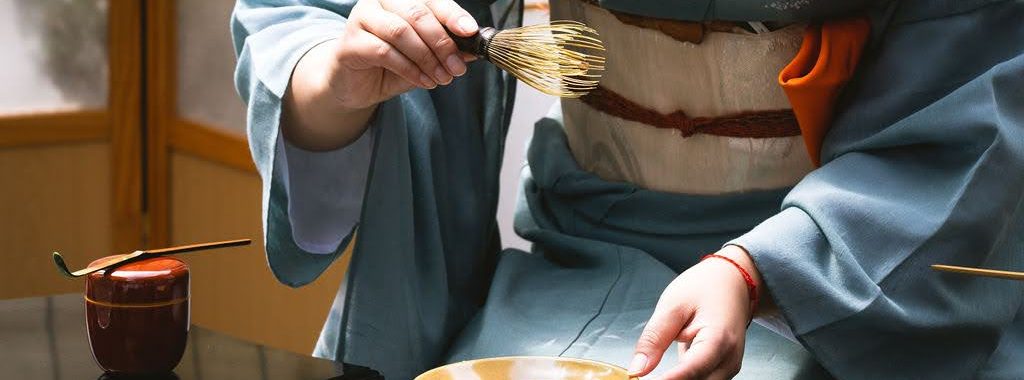
A close-up, eye-level shot focuses on the precise movements of a tea practitioner during a traditional Japanese tea ceremony. The practitioner, wearing a blue-grey kimono with a white and tan obi, is shown from the torso down. Her right hand delicately holds a bamboo tea whisk (chasen) over a shallow, golden-brown ceramic tea bowl (chawan) that she stabilizes with her left hand. To the left, a small, dark red lacquer tea caddy (natsume) sits on the polished black table, with a bamboo tea scoop (chashaku) resting across its lid. The background is softly blurred, showing the warm tones of a shoji screen and a reed mat, which maintains the focus on the ritualistic preparation. The lighting is bright and crisp, highlighting the textures of the bamboo whisk and the fine silk of the kimono, capturing a moment of quiet, intentional grace.

Nodate Tea Service 野点茶席

Presenters

The Dōjin Japanese Arts Society
(English/日本語)

Logo of the The Dōjin Japanese Arts Society with a moss green tatami room graphic, and organization name in English and Japanese.

Date & Time

Sunday, May 31, 2026

  • 1:00-1:50pm
  • 2:00-2:50pm
  • 3:00-3:50pm

Fee & Registration

$18 + fees & taxes.
20% off for members.
Book your tickets in advance on Eventbrite.
A limited number of tickets will be available in person on the day.

Enjoy the whisk of matcha with the seasonal breeze in the Nikkei Garden.

Celebrate the fragrant air of early summer with a nodate (outdoor) tea ceremony in the Omotesenke tradition, presented by The Dojin Japanese Arts Society. Guests will enjoy a seasonal sweet with a bowl of matcha prepared in the open air at a special tea table. Please join us for an opportunity to slow down and treat your senses to a special experience of the serene Nikkei Garden.

  • In the event of rain, sessions will move indoors with a view of the garden.

About The Dōjin Japanese Arts Society

Inspired by the era that witnessed the blossoming of numerous Zen-inspired arts—including Ikebana, tea ceremony, incense ceremony, Noh theatre, renga poetry, sumi ink painting, architectural and garden design — under the patronage of Shogun Ashikaga Yoshimasa in the late 15th century, Dōjin Arts aims to bring together experts in a wide range of different fields of Japanese arts to highlight the points of connection and commonality among the various traditional arts, offering our audience members and workshop participants a deeper understanding of the broader aesthetics, history, and cultural values that bring us together.
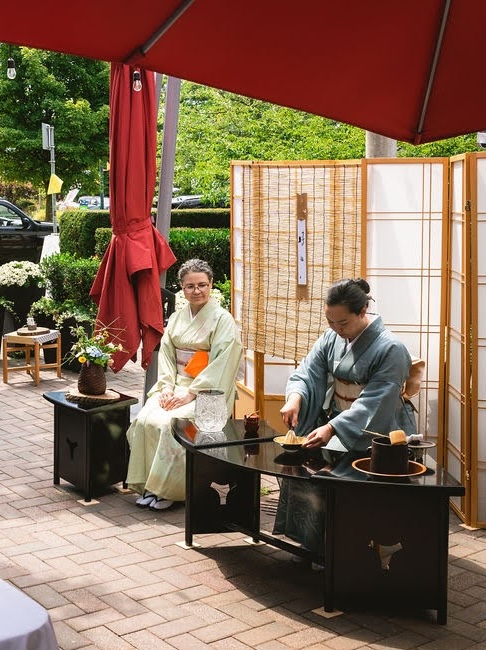
A high-angle, eye-level shot captures a traditional Japanese tea ceremony taking place outdoors on a brick patio under a large red umbrella. Two women, both in their late 40s or early 50s, are dressed in traditional kimonos. On the right, a woman in a blue-grey kimono is seated behind a black, curved wooden table, meticulously whisking matcha in a small bowl. Her dark hair is pulled back, and she is focused on the task. On the table, there are several tea-related items, including a wooden whisk, a small container, and a larger dark pot. To her left, another woman in a pale green kimono with an orange obi sash sits calmly, watching the ceremony. She has greyish-brown hair and wears glasses. Behind them, a tall, three-paneled shoji screen provides a backdrop, with a reed mat hanging in the center. The surrounding area features lush green trees and bushes
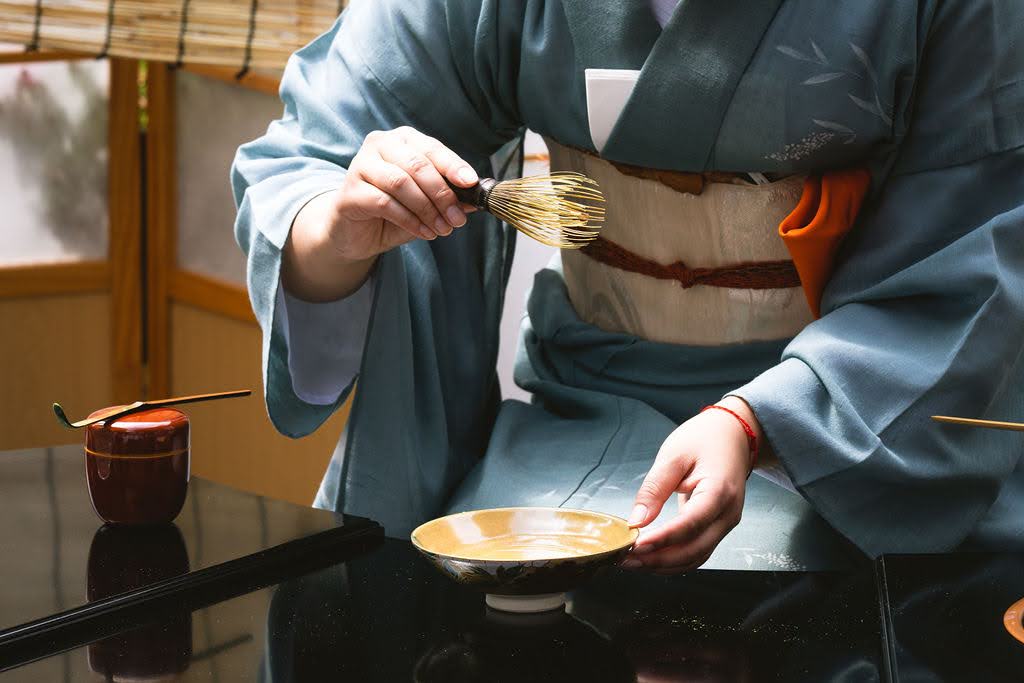
A close-up, eye-level shot focuses on the precise movements of a tea practitioner during a traditional Japanese tea ceremony. The practitioner, wearing a blue-grey kimono with a white and tan obi, is shown from the torso down. Her right hand delicately holds a bamboo tea whisk (chasen) over a shallow, golden-brown ceramic tea bowl (chawan) that she stabilizes with her left hand. To the left, a small, dark red lacquer tea caddy (natsume) sits on the polished black table, with a bamboo tea scoop (chashaku) resting across its lid. The background is softly blurred, showing the warm tones of a shoji screen and a reed mat, which maintains the focus on the ritualistic preparation. The lighting is bright and crisp, highlighting the textures of the bamboo whisk and the fine silk of the kimono, capturing a moment of quiet, intentional grace.